

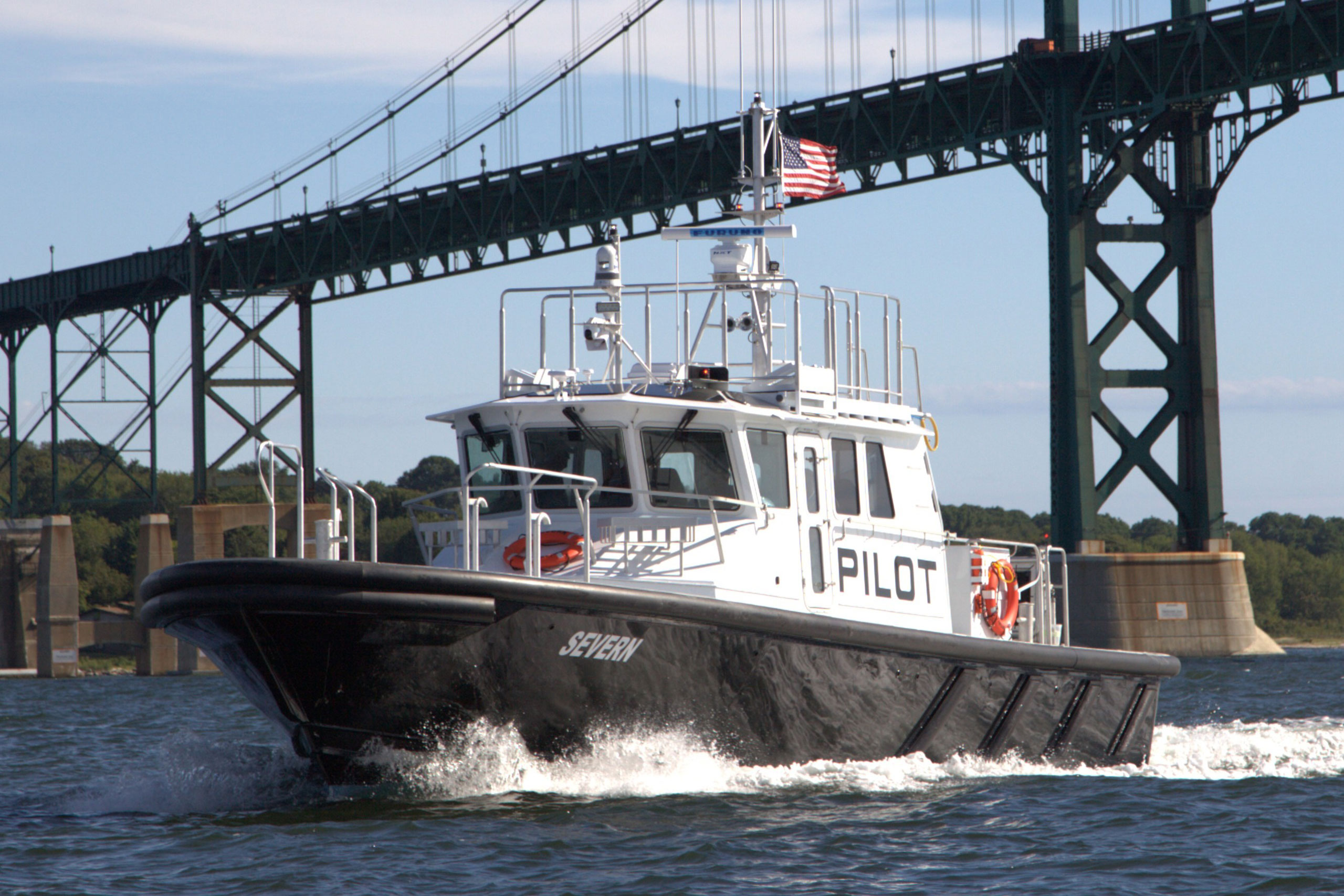
SOMERSET, Mass. – September 2, 2025 – The Association of Maryland Pilots has taken delivery of its fifth Chesapeake Class launch from Gladding-Hearn Shipbuilding, Duclos Corporation since 2002. “The Maryland Pilots have some unique features, and configuration control is essential to be sure their operators can seamlessly operate all the boats in their fleet. However, this must be balanced with new equipment and design updates, as well as, in some cases, retrofitting their existing boats. To make this happen over the span of 20-plus years requires a very high level of detail in the design and its execution,” explained Peter Duclos, president and director of business development.
With a deep-V hull designed by Ray Hunt Design, the new all-aluminum high-speed launch measures 52.6’ overall, with a 16.8’ beam and a 4.8’ draft. Powered by twin Volvo Penta D16, EPA Tier 3-certified diesel engines, each producing 750 Bhp at 1900 rpm. The vessel’s top speed is over 27 knots. A Humphree interceptor trim control system, with its Automatic Trim Optimization, is installed at the transom.
The engines turn 5-blade Bruntons NiBrAl propellers via ZF500-1-A gearboxes. The launch is equipped with a Northern Lights 12 kW genset.
The vessel’s wheelhouse, with a small trunk, is amidship on a flush deck. With electrically heated, forward-leaning front windows, the wheelhouse is outfitted with five Norsap shock-mitigating reclining seats, a baggage rack, and three weathertight doors. The forecastle includes a porta-potty, a split upholstered settee/bunk, and a custom storage rack for immersion suits and other safety gear. The vessels’ interior is heated and cooled by two 16,000 Btu reverse-cycle HVAC units, in addition to electric heaters located in the wheelhouse and forecastle.
Outside the wheelhouse, heated decks and handrails prevent ice accumulation. A Harken TR-31 safety rail system was installed on the wheelhouse handrail. An aft wheelhouse ladder leads to hinged boarding platforms on the roof. A control station at the transom features a hydraulically powered J-Basket rescue system, capable of retrieving a pilot from the water to the main deck in less than 10 seconds with a single operator, said Duclos.